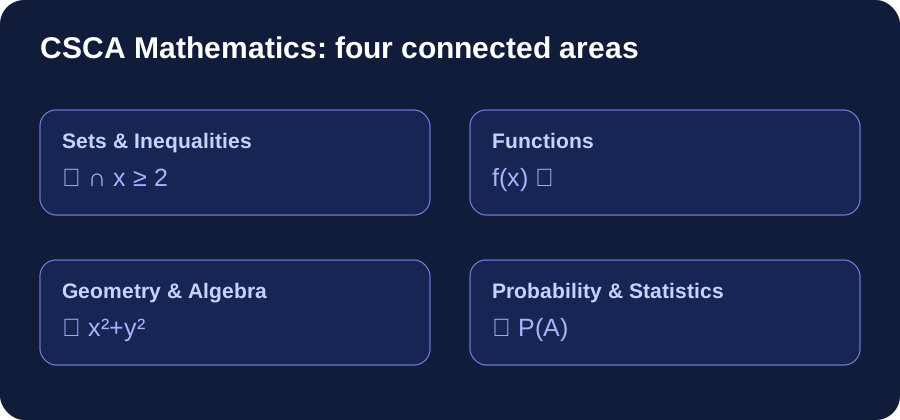
CSCA Mathematics
Build from the four syllabus modules, then practise the chapter where your accuracy is weakest.
Last reviewed Sep 2026 · GetCSCA editors
GetCSCA is a free CSCA practice site for students preparing for the China Scholastic Competency Assessment. Start with topic-filtered questions, review step-by-step answers, then build exam pace with a timed CSCA practice test or a full mock exam. Our Mathematics past papers are honest reconstructions based on student recall and the verified exam format, not official papers released by the organiser.
183 questions you can actually attempt today — 48 in the CSCA Standard bank and 135 reconstructed previous-exam questions, spread across 23 papers. The 8 questions whose source answer is disputed are withheld rather than marked, so nothing in the bank can teach you a wrong key.
Every question is labelled CSCA Standard difficulty, carries a per-question timer, and shows its derivation on reveal. 1095 questions across the papers are currently solvable end to end. Practice is free, needs no account, and stores progress only in your own browser.
If you are starting from zero, take the free 10-question diagnostic first — it seeds your progress model so the practice hub can rank your weak topics instead of showing an empty dashboard.
Use a repeatable loop instead of guessing what to study next: understand the syllabus, diagnose a weak area, learn it, practise, review mistakes, add time pressure, complete a mock, analyse the result, and repeat.
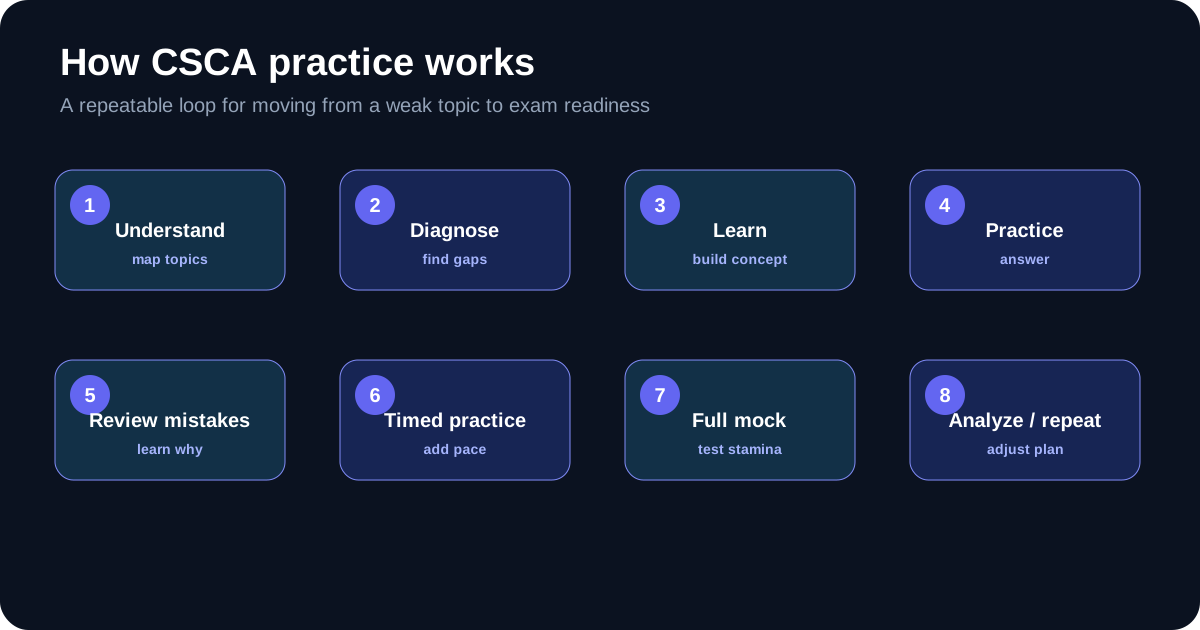
Start with the subjects and topics you need.
Use a first set to expose weak areas.
Study the lesson and formulas for that topic.
Answer focused CSCA questions without rushing.
Read the explanation and record the mistake cause.
Repeat under exam style time pressure.
Complete a complete CSCA style paper.
Review accuracy, timing and recurring errors.
Choose the subject that matches your programme, then use its study hub before returning to this practice bank.
Build from the four syllabus modules, then practise the chapter where your accuracy is weakest.
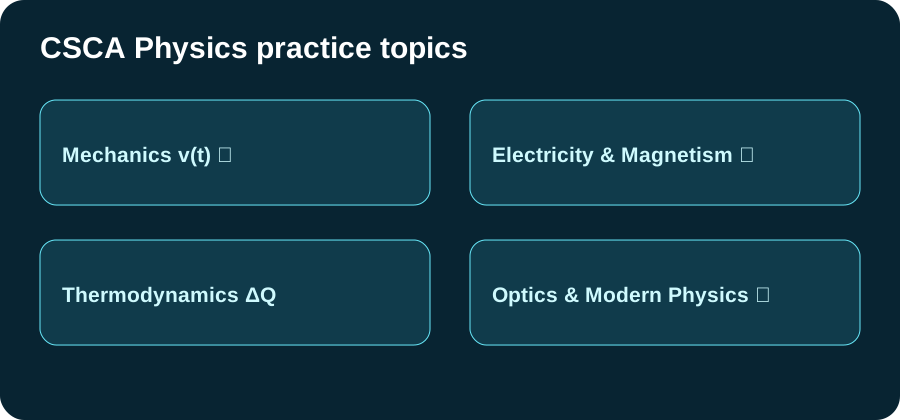
Use diagrams, units and formula conditions to turn physics concepts into faster decisions.
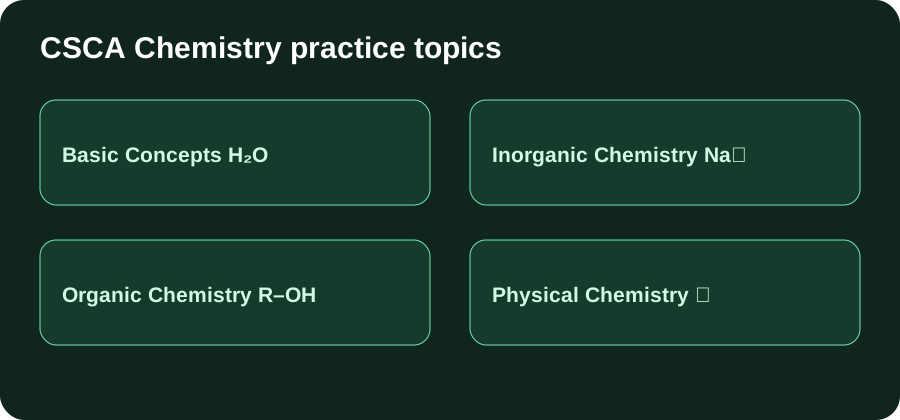
Connect concepts, equations and calculations through targeted chemistry practice.
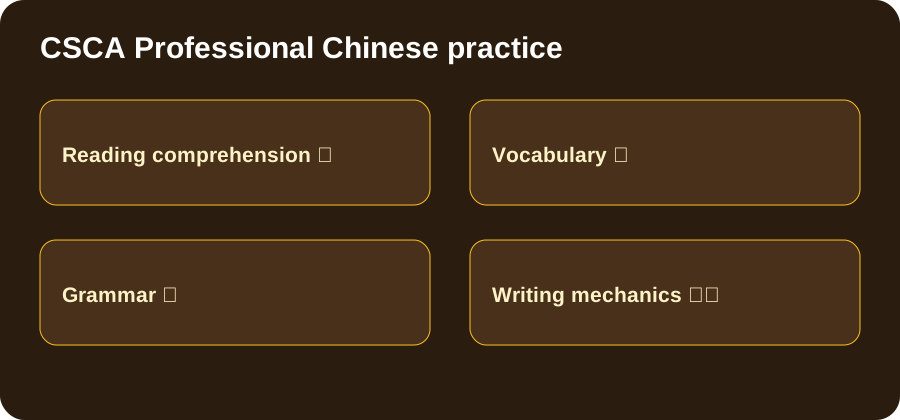
Prepare the language stream that matches your programme with reading and language practice.
Mathematics is a set of connected chapters, not one topic. Use the syllabus as your map, study one chapter, practise its questions, and return for timed work.
View the full CSCA Mathematics syllabus →Set notation and operations, Venn diagrams, and solving linear, quadratic and absolute-value inequalities.
Study chapter and practise →Domain and range, monotonicity, parity, and the power, exponential, logarithmic and trigonometric families.
Study chapter and practise →Arithmetic and geometric sequences and series: general terms, sums, and applied growth problems.
Study chapter and practise →Limits, derivative rules, and basic applications: tangents, monotonicity, extrema and simple optimization.
Study chapter and practise →Start with topic practice, add timing once your accuracy is stable, then use reconstructed paper practice and a full mock to test exam readiness.
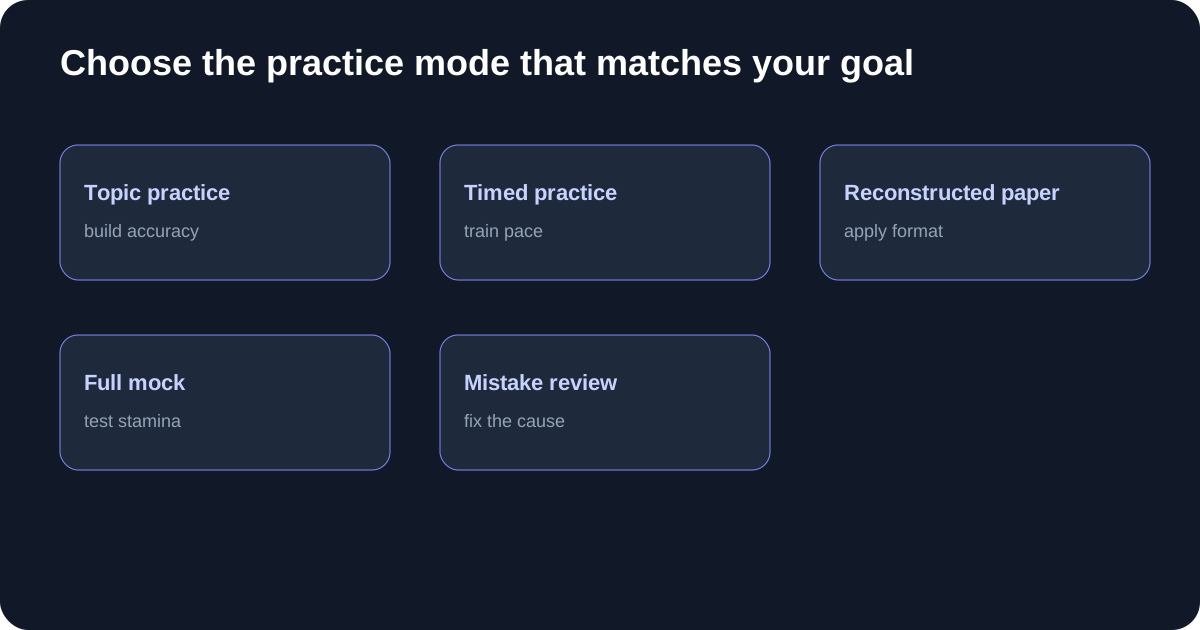
Learn a chapter and build accuracy.
Open topic practice →Train pace after untimed accuracy holds.
Open timed practice →Apply the format with clearly labelled reconstructed material.
Open reconstructed papers →Test stamina and decision making.
Open full mock exam →Choose a subject, open the chapter, study its lesson, practise questions, protect the skill in a timed set, and finish with a mock.
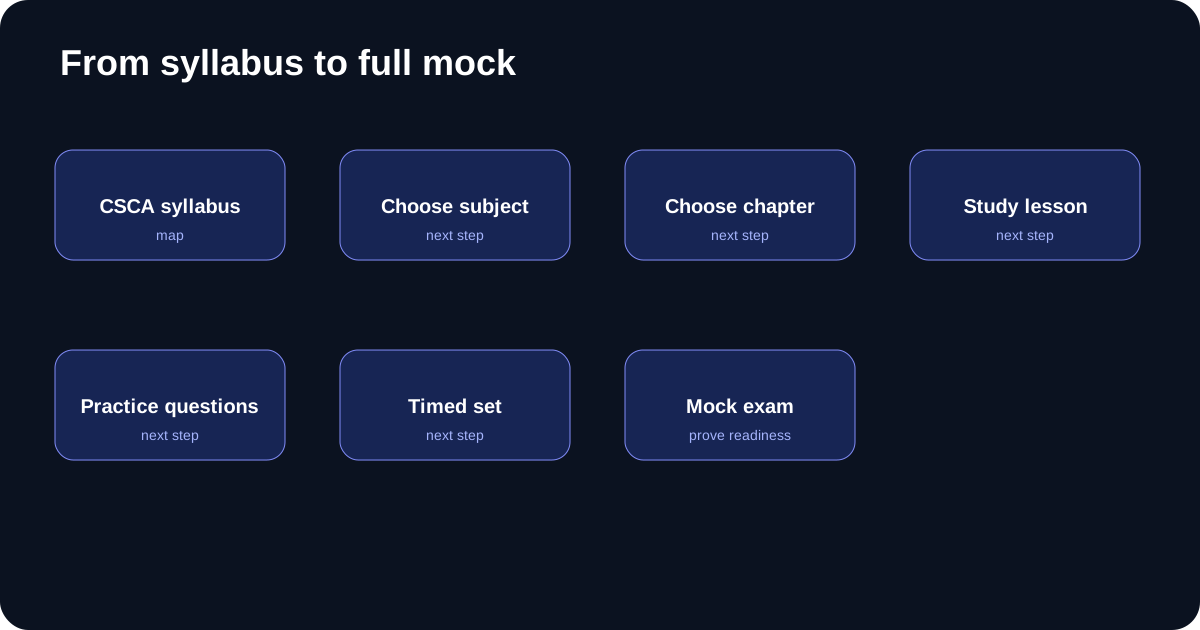
Start with the CSCA Mathematics syllabus to choose a chapter. Read the matching lesson on the Mathematics study hub, then come back here and filter the question bank by chapter or topic. Review every answer, file mistakes by cause, and use timed practice before attempting a full mock.
The questions on this page are practice material. Reconstructed papers are labelled clearly and are not official papers released by the organiser.
The bank holds 183 questions: a CSCA Standard set plus reconstructed previous-exam questions, all with step-by-step explanations. Eight disputed source-issue questions are withheld until the source error is resolved.
Yes, free, and no account. The whole bank, timed sets, mock exams and mistake tracking work in your browser with no signup and no paywall. Progress is stored locally on your own device.
No. The official organiser has never released past papers, so these are honest reconstructions built to the real format. Treat them as format-accurate practice, not as the leaked real paper.
Work the untimed bank until accuracy holds, then repeat under time. The exam is 48 questions in 60 minutes with no calculator, so budget about 75 seconds per question and rehearse the pace in timed sets before a full mock.
Each subject is scored 0-100 with no negative marking. There is no official pass mark — your university sets the cutoff. Tracking your score across timed mocks is the honest way to see whether you are ready.
Open the Mathematics syllabus, choose one chapter, read the linked lesson, then return to this practice bank and filter by the same chapter. Finish with a timed set before moving to a full mock.
Read the step-by-step explanation, record the cause in your Mistake Book, and retry the same topic later. Move to timed practice only after your untimed accuracy is stable.